
Planning a visit to Hanoi’s Old Quarter, wiring money to family in Ho Chi Minh City, or paying a supplier in Da Nang? Sooner or later, you’ll face the same question: how to convert CAD to VND without leaving money on the table. The Canadian dollar and the Vietnamese dong don’t just differ in colour and face value—they behave differently in markets, run on different banking norms, and come with their own practical quirks. This guide breaks it all down. You’ll learn how exchange rates really work, how to compare fees, where to get the best rates in Canada and Vietnam, how to move money safely, and what Canadians should know about rules, risks, and everyday spending in Vietnam.
Expect plain-English explanations, clear examples, and step-by-step tactics you can put to work immediately. We’ll cover banks, online platforms, cash exchanges, travel tips, and business strategies—all with a Canadian lens. By the end, you’ll know how to approach CAD to VND like a pro, no guesswork, no nasty fee surprises.
CAD and VND at a Glance
The Canadian dollar (CAD) is a free-floating currency overseen by the Bank of Canada. It’s deeply tied to global commodities—especially energy—and moves with interest rates, inflation expectations, and risk appetite in markets. Canadians know the drill: a hot jobs report or a surprise rate cut can jolt the loonie within minutes.
The Vietnamese dong (VND) operates differently. It’s a managed currency under the State Bank of Vietnam. While market forces matter, the central bank actively stabilizes the dong, which means sudden swings are less common than, say, the moves you see between CAD and USD. Vietnam is a fast-growing, export-driven economy; manufacturing, electronics, textiles, and agriculture are major pillars. That backdrop encourages a stable exchange environment, especially around trade settlement and investment flows.
On the ground, VND is a cash-friendly currency with big numbers. Prices are in the thousands and millions of dong. You’ll handle notes more than coins, and you may see merchants quote prices without the last three zeros in casual conversation. If a street vendor says “50,” they almost certainly mean 50,000 VND.
The Banknotes You’ll See in Vietnam
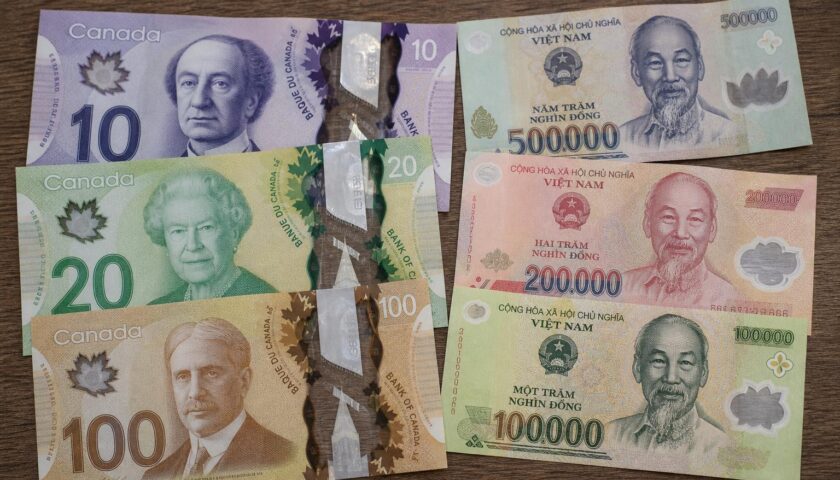
Vietnam’s modern banknotes are polymer (durable and water-resistant), which helps in the heat and humidity. You’ll commonly encounter these denominations:
| Denomination (VND) | Common Use | Tip |
|---|---|---|
| 500,000 | Hotels, larger bills, intercity travel | Break these at supermarkets or big shops; small vendors may lack change. |
| 200,000 / 100,000 | Restaurant meals, taxis, attractions | Good for mid-sized purchases. |
| 50,000 / 20,000 | Street food, coffee, short rides | Keep a stack for daily spending. |
| 10,000 / 5,000 / 2,000 | Very small purchases, markets | Useful for exact change; don’t toss them. |
Note colours are similar, and the extra zeros can be disorienting at first. Slow down, read the number, and double-check change. It’s not rude—it’s normal.
How the CAD to VND Exchange Rate Really Works
When you Google “CAD to VND,” you’ll see a number. That’s usually the mid-market rate—the midpoint between the buy and sell prices on global currency markets. It’s the “real” rate big players trade at, not what you’re likely to get as a retail customer. Providers add a markup and charge fees, both of which can be bigger than you think.
Three elements determine what hits your pocket:
- Mid-market rate (the reference rate you see on sources like XE, OANDA, or Google)
- Exchange spread (provider’s markup over the mid-market)
- Fees (fixed charges, percentage fees, ATM fees, network fees, or receiving fees)
That’s why two services can show the same “rate” yet land you different totals in Vietnamese dong. One may hide its revenue in a bigger spread and charge low fees. Another may use the mid-market rate but add a transparent percentage fee. You don’t care about the structure—you care about the total VND that arrives.
What Moves CAD/VND Day to Day?
It’s not random. For CAD:
- Bank of Canada policy and inflation data shift expectations.
- Oil prices ripple through the loonie—more demand for Canadian exports can support CAD.
- Global risk sentiment matters: when markets seek safety, smaller commodity currencies can soften.
For VND:
- State Bank of Vietnam policy aims for stability.
- Export performance and foreign direct investment influence inflows.
- US dollar strength or weakness can filter through to the dong, particularly if exporters and importers hedge around USD pricing.
The result: CAD/VND tends to move less wildly than CAD against some major floats, but you’ll still see trends as oil, interest rates, and global trade shift. Watching CAD/USD and USD/VND often gives quick context for CAD/VND movements.
Live Rate vs. What You Actually Get
Let’s make it tangible. Suppose the live mid-market rate is 1 CAD = 18,500 VND (example rate only). You’re evaluating a transfer of 1,000 CAD.
- Service A: uses the mid-market rate, charges a 0.6% fee + a small fixed fee. You might end up with roughly 1,000 × 18,500 × (1 − 0.006) minus a few dollars. That’s around 18,389,000 VND, give or take.
- Service B: “no fee,” but builds a 2.5% markup into the exchange rate, effectively using 18,037.5 VND per CAD. You get around 18,037,500 VND. No fee, but less dong.
- Your bank: a $15 wire fee + 2.5–3.5% FX markup + potential $10–$20 receiving fee on the Vietnam side. Your total could be lower again—sometimes much lower.
Notice how a small-sounding percentage eats real spending power. With large transfers, the difference can equal several days’ travel budget or a month of groceries in Vietnam.
Typical Provider Costs at a Glance
| Provider Type | Exchange Rate | Fees | Speed | Notes for Canadians |
|---|---|---|---|---|
| Major Canadian banks (RBC, TD, Scotiabank, BMO, CIBC) | Often mid-market minus 2–4% | $0–$30+ send fee; receiver may pay | 1–3 business days (wire); cash ordering varies | Convenient, but pricier; VND cash may require pre-order |
| Online money transfer apps (Wise, Remitly, WorldRemit, Xe) | Close to mid-market | Transparent % + fixed fee | Minutes to 1–2 days | Often cheaper; Interac e-Transfer funding may be supported |
| Currency exchange bureaus (Calforex, VBCE, Continental) | Competitive; varies by city and amount | Usually built into rate | Immediate if in stock | Call ahead for VND availability in Canada |
| Airport kiosks | Weak rates | Sometimes low posted fees, but high markup | Instant | Use only for small emergencies |
Where to Convert CAD to VND in Canada
You have four main options: your bank, a credit union, a specialty currency exchange, or waiting to exchange in Vietnam. Each has a place, depending on your situation.
Canadian Banks
RBC, TD, Scotiabank, BMO, and CIBC can arrange foreign currency cash, but Vietnamese dong may not be stocked at every branch. You’ll often need to pre-order and wait a few days. The upside: safety and convenience. The trade-off: wider spreads. For small amounts, the convenience might be worth it; for larger sums, you’ll likely pay for that ease.
If you’re transferring money, banks can wire funds to Vietnam using SWIFT. Expect a send fee, a less favourable exchange rate, and a receiving charge from the Vietnamese bank. If the recipient needs cash pickup, bank wires aren’t ideal—use a remittance app with cash partners instead.
Credit Unions
Credit unions like Vancity or Desjardins may offer foreign exchange or partner with third-party FX providers. Rates can be competitive, but availability of VND cash is hit-and-miss. Always call ahead and ask about:
- The exact all-in rate (not just the “mid-market reference”).
- Any order minimums or delivery timelines for VND banknotes.
- Return policies if you bring unused cash back to Canada.
Specialty Currency Exchanges
In major cities, dedicated exchange houses often beat banks on price. In Vancouver, VBCE (Vancouver Bullion & Currency Exchange) is well-known; in Calgary and Edmonton, Calforex is common; in Toronto and Montreal, you’ll find several reputable counters downtown. Call two or three shops to compare quotes. Ask whether the quoted rate is the final walk-away rate and whether VND is immediately available.
Tip: exchange bureaus post rates that can move during the day. If you’re changing a large amount, ask if they’ll lock a rate while you travel to the branch.
Exchanging in Vietnam Instead
Many travellers change a small amount of CAD to VND in Canada—enough for the first day or two—then do the bulk in Vietnam. You’ll often find better rates at:
- Bank branches (Vietcombank, BIDV, VietinBank, Sacombank, Techcombank), though expect formalities and banking hours.
- Licensed gold/jewellery shops in tourist areas; these are a local staple for FX. Stick to reputable, well-reviewed counters.
Bring crisp, clean Canadian bills. Worn or marked notes may be refused or discounted. Rates vary by city and even by street; in places with lots of tourists, competition keeps spreads tight. Don’t exchange at airports unless you must.
Sending Money from Canada to Vietnam
When you need to send CAD to VND, you can choose a bank wire or a specialist money transfer service. Focus on the total VND the recipient gets, the delivery time, and the safety of the provider.
Bank Wires (SWIFT)
A bank wire from a Canadian bank goes through the SWIFT network. It’s reliable but can be costly. You’ll pay a sending fee in Canada, plus an exchange rate markup. Intermediary banks and the receiving bank (e.g., Vietcombank, BIDV, VietinBank, Sacombank) may deduct additional fees. Delivery typically takes 1–3 business days, sometimes longer if compliance checks are needed or if a US correspondent is involved for USD legs.
Best for: higher-value business payments where bank-to-bank is necessary, or when a recipient prefers settlement to a specific VND account they already use for bills or payroll.
Online Money Transfer Services
Platforms like Wise, Remitly, WorldRemit, Xe, and OFX specialize in cross-border transfers. They usually offer better CAD to VND rates than banks and faster delivery. Many allow you to fund the transfer by EFT from your Canadian bank account, debit card, or even Interac e-Transfer. On the receiving end, options can include bank deposit in VND, cash pickup at partner locations, or—in some cases—top-up to popular Vietnamese wallets like MoMo or ZaloPay.
Best for: remittances to family, small business invoices, and any transfer where the total received and speed matter more than sticking with your bank branch.
Cash Pickup Networks
If your recipient prefers cash, choose a service that supports pickup. Major partners in Vietnam commonly include Vietcombank, BIDV, VietinBank, and Sacombank branches, along with designated agent locations. The sender gets a reference number; the recipient presents ID to collect cash in VND. Payouts are often available within minutes after your transfer is approved.
How to Compare Transfer Options—Step by Step
- Enter the same send amount (e.g., 1,000 CAD) on 2–3 provider websites/apps.
- Note the exchange rate, all fees, and the delivery estimate.
- Calculate the exact VND that arrives—most apps show this up front.
- Check receiving options: bank deposit, cash pickup, or wallet top-up.
- Confirm the provider is registered with FINTRAC (see “Regulation and Safety”).
- Consider support channels and refund policies if a transfer is delayed.
Worked Example: The Real Cost Difference
Assume an example mid-market of 1 CAD = 18,500 VND and a 1,000 CAD transfer.
- Bank wire: $15 send fee + 3% markup → effective rate ~17,945 VND/CAD. Total before any receiving fees: ~17,945,000 VND.
- Remittance app A: mid-market rate + 0.6% fee (~$6) → ~18,389,000 VND.
- Remittance app B: “no fee,” 2% markup → ~18,130,000 VND.
Even modest-sounding differences add up. With larger transfers—say 5,000 CAD—the gap can be hundreds of thousands of dong, enough to noticeably change someone’s monthly budget in Vietnam.
Regulation and Safety: What Canadians Should Know
In Canada, companies that move money or exchange currency generally must register as Money Services Businesses (MSBs) with FINTRAC (Financial Transactions and Reports Analysis Centre of Canada). This registration helps ensure anti-money laundering and counter-terrorist financing controls are in place. Before using a non-bank provider, look them up on FINTRAC’s MSB registry. If you can’t find them, walk away.
Expect identity verification. Providers may ask for government-issued ID, proof of address, and—above certain thresholds—proof of source of funds. These checks aren’t personal; they’re legal requirements.
Cross-border cash rules matter too. When entering or leaving Canada, you must report if you’re carrying CAD 10,000 or more (or the equivalent in any currency) in cash or monetary instruments. In Vietnam, you generally must declare foreign currency in cash over the equivalent of USD 5,000, or Vietnamese dong in cash over a set threshold (commonly cited at 15 million VND). If you’re moving large sums physically, read both countries’ current rules before you fly. The safest approach: keep cash modest and use regulated transfers for the bulk.
Scam radar on: no legitimate provider guarantees a fixed exchange rate far above market. Be wary of social media “helpers,” requests to pay strangers by gift cards, or anyone pressuring for immediate action. If something feels off, it probably is.
Everyday Spending in Vietnam: Practical Tips for Canadians
Vietnam is wonderfully affordable by Canadian standards. You can eat well, get around easily, and enjoy top-tier coffee without draining your travel budget. The trick is managing your CAD to VND conversion and payment methods smartly.
ATMs and Card Use
ATMs are everywhere in cities and tourist towns. Most accept foreign cards with Visa or Mastercard logos. You’ll pay:
- A fee from the Vietnamese ATM operator (varies; often posted on-screen).
- Your Canadian bank’s out-of-network ATM fee (commonly $3–$5).
- A foreign exchange markup from your bank or card (often 2.5%).
Combined, withdrawing cash with a typical Canadian debit card can cost 3–6% or more. If you hold a no-foreign-transaction-fee credit card, use it where accepted (mid-range hotels, larger restaurants, and shops). But Vietnam still runs on cash. Keep small notes handy for markets, street food, taxis, and rural areas.
Some ATMs or card terminals offer “Dynamic Currency Conversion” (DCC), asking if you want to be charged in CAD. Decline it. Always choose to be charged in VND. DCC layers in a poor exchange rate.
When to Exchange vs. Withdraw
For many travellers, the sweet spot is a mix:
- Bring a small float of VND or USD for day one (airport transfer, first meal).
- Withdraw VND from ATMs as needed, ideally in larger amounts less often to spread the fixed fees.
- Use a competitive exchange counter in town if you hold clean CAD bills and find a strong rate.
If you hold a Canadian card with no FX fee and decent cash advance terms (rare), you could rely more on ATMs. Otherwise, aim to minimize withdrawals and compare a local exchange counter’s VND rate for any larger cash need.
Typical Costs to Budget
Prices vary by city and season, but a quick sense check:
- Local meal: 40,000–100,000 VND
- Coffee: 20,000–60,000 VND (specialty cafes higher)
- App-based ride (short city trip): 20,000–60,000 VND
- Mid-range hotel: 600,000–1,800,000 VND per night
- Intercity bus or train: depends on distance and class; budget-friendly by Canadian standards
These ballparks will shift with inflation and location. The key is to convert quickly in your head: if 1 CAD is roughly “eighteen to nineteen thousand VND,” then 100,000 VND sits near “about five to six Canadian dollars” at many points in recent years. Check the live rate when you travel.
Tipping and Small Transactions
Tipping isn’t default in the way it is in Canada, but it’s appreciated for exceptional service, guided tours, or hotel staff. Round up taxi fares; leave some notes at restaurants if you’re pleased. Always ask for the price before boarding a cyclo or taking a non-metered ride, and use reputable ride-hailing apps where possible to anchor the fare in VND.
CAD to VND for Students and Families
Hundreds of thousands of Canadians have Vietnamese roots, and family remittances are common. If you send money regularly, you can reduce costs without sacrificing speed or safety.
Strategies for Recurring Remittances
- Use mid-market benchmarks: compare each transfer against the live CAD to VND rate to keep providers honest.
- Automate: some services let you schedule monthly payments, sometimes with lower fees.
- Batch where sensible: one 1,000 CAD transfer is often cheaper than two 500 CAD transfers, due to fixed fees.
- Avoid weekends: spreads can widen when markets are closed. Midweek often sees tighter pricing.
- Rate alerts: set notifications when CAD strengthens; send a bit extra that month if timing is flexible.
Ask recipients what’s easiest for them: cash pickup, bank deposit, or wallet top-up. In cities, bank deposit is convenient; in rural areas, cash pickup may be simpler. Verify the recipient’s name exactly as on their government ID to avoid delays.
For Canadian Businesses Paying Vietnam
Whether you’re importing textiles, sourcing software development, or paying a consultant in Ho Chi Minh City, how you structure CAD to VND payments affects margins and relationships.
Pick the Right Settlement Currency
Many Vietnamese suppliers price in USD for international work. If you pay in USD, you’ll handle CAD to USD conversion (and the supplier avoids VND volatility). If you pay in VND, clarify who bears FX risk between invoicing and payment. Consider:
- Pricing currency: USD may simplify quotations; VND can be advantageous if your counterpart prices locally.
- Payment rails: bank wire vs. specialized FX firm (OFX, Wise Business, Moneycorp, Xe) with better rates and bulk tools.
- Contracts: include clauses for FX movements beyond a band, or discounts for early payment.
Hedging and Rate Tools
- Forward contracts: lock an exchange rate for future payments to stabilize costs.
- Market orders: set target rates; the provider executes when the market hits your level.
- Batch payments: consolidate multiple invoices to reduce per-transaction fees.
Specialist FX providers often integrate with accounting software and offer dedicated support. For recurring flows, those perks plus better CAD to VND rates can outweigh the comfort of a big-bank brand.
Documentation and Compliance
Expect Know-Your-Customer (KYC) and source-of-funds checks, especially as amounts grow. Maintain contracts, invoices, and proof of delivery. If you’re importing goods into Canada, comply with CBSA rules and maintain records for the Canada Revenue Agency. When in doubt, seek professional advice; the small upfront cost beats downstream headaches.
CAD to VND: History and Outlook (Without Crystal Balls)
Over the past decade, CAD has cycled with energy prices and interest rates. The dong has been relatively steady under a managed regime. When oil slumps or global growth wobbles, CAD can soften against USD, which can trickle through to CAD/VND. Conversely, a firm commodity cycle and rate differentials favouring Canada can buoy the loonie.
Vietnam’s long-run growth story—manufacturing upgrades, infrastructure investment, and rising domestic consumption—supports a stable policy approach for VND. But no currency is immune to global shocks. If you’re transferring a life-changing sum, consider splitting the timing (dollar-cost averaging) or using a hedge. For routine transfers, consistency beats bravado.
Calculate CAD to VND Like a Pro
Don’t trust slogans. Do the math. Here’s a simple framework:
- Find the live mid-market rate for CAD to VND on a trustworthy source.
- Get a provider’s actual rate and fees for your specific amount and route (bank deposit vs. cash pickup).
- Compute total VND received: Send CAD × Provider Rate − Fees Converted to VND (if fees are in CAD, subtract in CAD first, then convert).
Example with placeholders (for illustration only):
- Mid-market: 1 CAD = 18,500 VND
- Provider X rate: 18,350 VND/CAD, fee $4.50
- Send 1,000 CAD → Convert 995.50 CAD at 18,350 → 18,267,425 VND received
Repeat for Provider Y and Z, then pick the highest VND outcome, provided the delivery time and receiving method suit your needs. Save a screenshot of each quote; you’ll learn how often each provider wins for your typical transfer size and destination bank.
Common Pitfalls—and How to Dodge Them
Even savvy Canadians can trip on small details that cost big money. Here’s what to watch for.
- Dynamic Currency Conversion (DCC): Decline any ATM or card terminal “helpfully” offering to bill you in CAD. Always choose VND.
- Weekend markups: If you don’t need the money urgently, wait for weekday markets and tighter pricing.
- “No-fee” traps: The fee is usually in the rate. Compare the total VND, not the marketing line.
- Old or damaged cash: Vietnam’s exchange counters prefer crisp notes. Torn or marked bills may be rejected or discounted.
- Underestimating ATM costs: Stack operator fees, your bank’s fee, and FX markup. You may be paying more than you think.
- Wrong recipient details: A misspelled name can stall a transfer. Match the recipient’s ID exactly, including diacritics if applicable.
- Unregistered providers: Verify FINTRAC registration for Canadian-facing services. If it’s not there, don’t send.
Tools and Resources Canadians Actually Use
- Your bank’s app: for quick wires, but compare rates before you pull the trigger.
- Currency trackers: XE, OANDA, and Google for the mid-market reference.
- Bank of Canada: policy statements and rate decisions that move CAD.
- FINTRAC MSB Registry: confirm a transfer service is properly registered in Canada.
- Transfer platforms: Wise, Remitly, WorldRemit, Xe, OFX—use them to quote exact CAD to VND outcomes.
- Government travel sites: for current customs declaration thresholds and travel advisories.
Set a routine: before each transfer or trip, check the live rate, compare two providers, and glance at BoC headlines. It takes 10 minutes and can save you real money.
Pre-Trip or Pre-Transfer Checklist
- Look up the live CAD to VND rate; write it on your phone’s notes app.
- Quote two providers for your amount and method (bank deposit vs. cash pickup).
- Decide: bring a little VND or USD, then do the bulk in Vietnam or via a transfer app.
- Tell your bank you’re travelling (if using cards) to avoid fraud blocks.
- Photocopy or securely store images of your IDs and cards.
- Know your limits: CAD 10,000+ must be declared at Canadian borders; Vietnam has its own thresholds for cash declarations.
- Download a ride-hailing app accepted in Vietnam and add your card.
- Turn off DCC by habit: always pay in VND abroad.
Advanced Notes: Cash, Cards, and Quiet Optimizations
Small tweaks add up:
- Use a no-FX-fee credit card for larger in-person purchases in Vietnam. Pay it off promptly.
- If withdrawing cash, try banks that allow higher per-withdrawal limits; fewer withdrawals mean fewer fixed fees. Limits vary by ATM and card type; observe the on-screen cap.
- Keep a photo of your passport on your phone for hotel check-ins and SIM purchases; you’ll need the physical passport too, but the photo speeds things up.
- Test a small transfer to a new recipient before sending a large amount. It confirms details and payout logistics.
- For business, ask suppliers for a small early-payment discount—then compare if the FX savings + discount beat waiting for an imaginary “perfect” rate.
Example Scenarios for Canadians
The Two-Week Traveller
You land in Hanoi with $150 CAD in VND already, enough for a taxi, dinner, and a night’s stay. On day two, you exchange $300 CAD at a reputable shop you found via recent reviews. For the rest, you withdraw VND twice from ATMs—larger amounts each time—to reduce fixed fees. You always refuse DCC. Net result: you balance convenience and cost, and your total FX expense stays modest.
The Family Remitter
You send 700 CAD monthly to family in Ho Chi Minh City. You’ve compared CAD to VND rates across three services and set alerts. Over six months, Provider A consistently pays out the most VND for your amount and route. You schedule a monthly transfer right after your paycheque, midweek. Over a year, these habits save enough to fund an extra transfer.
The Importer
You pay suppliers in Binh Duong Province in USD, with invoices due net-30. You negotiate a 0.5% discount for paying within 7 days and use a forward contract to fix your CAD/USD rate for the quarter. Your specialist FX account integrates with your accounting software, and batch payments reduce per-transaction fees. Your landed costs are predictable; your margins, steadier.
Understanding Availability of VND in Canada
VND is less commonly stocked in Canada than euros or US dollars. Rural branches may not carry it at all; major urban branches and FX houses may require a few days’ notice. If you can’t source VND before departure, don’t panic. Bring a reasonable amount of CAD or USD in clean bills to convert in Vietnam, and have a debit/credit card as backup. Always split cash between bags and keep photocopies of key documents.
What If You’re Paid in VND?
Freelancers or remote employees working with Vietnamese companies sometimes receive VND. You can:
- Ask to be paid in CAD or USD if possible; it’s often simpler for Canadian residents.
- Use an online platform that can receive VND and convert to CAD, comparing rates and fees.
- Track all income carefully for Canadian tax purposes; exchange rate records on the day funds hit your account help your bookkeeping.
When clients insist on VND, negotiate who covers fees and what rate reference you’ll use. Clarity prevents awkward conversations later.
How Much VND Should You Carry?
Enough for daily spending and a cushion, not so much that you worry about safety. In major cities, you can replenish easily via ATMs or exchanges. For rural trips or overnight trains, carry more cash—there may be long gaps without reliable ATMs. Keep large notes for hotels and tours; use smaller notes for food and local transport.
Security and Common-Sense Habits
Vietnam’s tourist areas are generally safe, but pickpocketing happens. Use a money belt or a crossbody bag with zippers. Split cash between pockets and bags. In crowded markets, keep one hand on your bag. In bars and night markets, stay alert when paying; count change slowly, in view, and don’t rush if someone appears impatient.
Glossary: CAD to VND Terms You’ll See
- Mid-market rate: The midpoint between buy and sell rates in interbank markets.
- Spread/markup: The provider’s margin embedded in the exchange rate.
- SWIFT: The messaging network used by banks to move money internationally.
- DCC (Dynamic Currency Conversion): A card processing “feature” that bills you in your home currency at a poor rate. Decline it.
- FINTRAC: Canada’s financial intelligence unit; it registers and oversees MSBs.
- FX hedge: A contract (like a forward) to lock in an exchange rate for the future.
Final Thoughts: A Smart, Simple CAD to VND Playbook
Converting CAD to VND doesn’t need to be complicated. Anchor yourself on the real rate, compare two providers every time, and pick based on the total dong delivered. For travel, carry a graceful mix of cash and cards, dodge DCC, and withdraw strategically. For remittances, automate and batch where it makes sense. For business, choose your settlement currency carefully and consider hedging.
Do these small things well, and the savings will keep showing up—in better meals, smoother logistics, and a little extra left over when you fly home.
FAQ: CAD to VND for Canadians
How much is 1 CAD in VND right now?
Rates change by the minute. Check a live source like XE, OANDA, or Google for the mid-market CAD to VND rate. Remember: your provider’s actual rate after fees may differ. Always compare the final VND you’ll receive.
Is it better to exchange CAD to VND in Canada or in Vietnam?
Often, you’ll get stronger rates in Vietnam from banks or reputable exchange counters. Many Canadians bring a small amount of VND (or USD) for day one, then exchange or withdraw the rest locally. If convenience matters most, pre-order at your Canadian bank or an FX house and accept a slightly weaker rate.
Can I withdraw VND from ATMs in Vietnam with a Canadian card?
Yes. Most ATMs accept Visa and Mastercard. Expect an ATM operator fee, a Canadian bank out-of-network ATM fee, and a foreign exchange markup. Withdraw larger amounts less often to minimize fixed fees, and always decline Dynamic Currency Conversion.
Which Canadian banks offer VND cash?
Major banks can usually order VND to a branch with notice, but it’s not always stocked. Call ahead to RBC, TD, Scotiabank, BMO, or CIBC and ask about availability, timing, and the all-in rate.
What’s the cheapest way to send money from Canada to Vietnam?
There’s no single winner. For many amounts and routes, online services like Wise, Remitly, WorldRemit, or Xe beat banks on CAD to VND by using tighter spreads and transparent fees. Compare providers for your exact amount and payout method (bank deposit vs. cash pickup). Choose the one that delivers the most VND safely and quickly.
Are money transfer services safe?
Use only regulated providers. In Canada, verify registration on the FINTRAC MSB registry. Stick to well-established brands with strong reviews and clear support channels. Avoid social media “middlemen.”
Do I need to declare cash when travelling between Canada and Vietnam?
In Canada, you must declare CAD 10,000 or more (or equivalent) when entering or leaving. Vietnam requires declarations for cash above its own thresholds (commonly USD 5,000 equivalent for foreign currency, or a set limit in VND). Check the latest rules before you fly.
Is VND a “closed” currency?
VND isn’t widely traded offshore like EUR or USD, but visitors can exchange it locally, withdraw from ATMs, or receive remittances. In Canada, VND cash is less commonly stocked, which is why many travellers exchange once in Vietnam.
Should I pay in VND or ask a merchant to charge me in CAD?
Always pay in VND. If a terminal offers to bill you in CAD (Dynamic Currency Conversion), decline it. DCC rates are typically worse than your card issuer’s conversion.
Can I fund transfers with Interac e-Transfer?
Many online remittance providers operating in Canada accept Interac e-Transfer as a funding method, alongside bank debits and cards. Check the app’s payment options during setup.
What about weekend transfers?
When FX markets are closed, some providers widen spreads or use Friday’s rate with a buffer. If timing is flexible, send midweek. If not, compare anyway—differences still exist between providers.
Are tips expected in Vietnam?
Not typically like in Canada, but tips are appreciated for excellent service, guides, and hotel staff. Round up fares and leave small notes as thanks. There’s no strict rule—follow local cues.
Can I convert leftover VND back to CAD in Canada?
Possibly, but not every Canadian exchange will buy VND, and the rate may be weak. It’s easier to spend down your VND before departure, convert in Vietnam, or keep a small amount as a souvenir. If you must sell in Canada, call exchange houses first to confirm they buy VND and at what rate.
What documents do I need for a bank wire to Vietnam?
You’ll need the recipient’s full name, bank name, branch details, and account number. A SWIFT/BIC code helps route the transfer. Some banks will ask for the reason for payment and may require supporting documents for larger amounts.
How do I get the best possible CAD to VND rate?
Use the mid-market rate as your yardstick. Compare at least two providers each time. Avoid airport exchanges, decline DCC, send midweek when possible, and batch transfers to reduce fixed fees. For bigger amounts, consider specialist FX firms with business tools or forwards.