
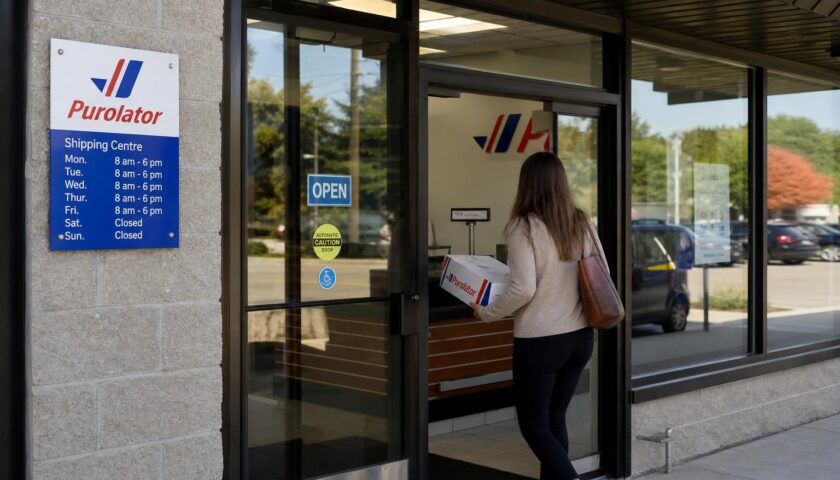
You’ve got a parcel ready, a deadline breathing down your neck, and a dozen tabs open trying to figure out where to take it. If that sounds familiar, you’re in the right place. This guide walks you through every part of a Purolator drop off in Canada—from choosing the right service and packing properly to finding the best location, dodging surcharges, and knowing what actually happens after you hand over the box. You’ll come away knowing exactly where to go, what to bring, and how to get your shipment moving without surprises.
Whether you ship a few returns a year or you’re the unofficial logistics manager for a small business, the way you handle drop-offs can make a real difference—fewer delays, cleaner tracking, lower costs, and less back-and-forth with customers or family waiting on the other end. Let’s make this the last time you wonder “Where do I drop off a Purolator package near me?” and the first time you feel fully in control of the process.
What “Purolator drop off” actually means
“Purolator drop off” is a catch-all phrase people use for several different options. Understanding the differences saves time and prevents the classic “Oops, they don’t accept this type of shipment here” moment.
Purolator Shipping Centres (depots)
These are Purolator’s own facilities. They handle the widest range of services: domestic and international shipping, printing labels, packaging advice, purchasing supplies, and resolving common issues. If you’re unsure about something—customs forms, dangerous goods rules, or whether your box is over the size limit—this is the safest bet. Shipping centres are usually located in industrial and commercial areas of major Canadian cities, with posted daily cut-off times for same-day processing.
Authorized Shipping Agents (retail partners)
Authorized agents are independent retailers trained to accept Purolator packages. They’re often located in places that are easy to reach—think busy retail streets or shopping plazas—with longer evening and weekend hours than most depots. Agents typically accept pre-labelled packages, can sell labels, and may stock Purolator packaging (envelopes, packs, boxes). They don’t always offer specialized services like dangerous goods, and cut-off times vary by store.
Purolator Drop Boxes
These self-serve boxes are placed in high-traffic areas like office towers, campuses, and lobbies. They’re for small, pre-labelled, non-regulated shipments only—usually documents and light parcels. No receipts are issued on the spot, and there are strict size and weight limits posted on each box. Daily pickup times are printed on the unit. If you need a paper trail at the moment of handoff, use a staffed counter instead.
On-demand pickups (an alternative when drop-off isn’t ideal)
Not technically a drop-off, but worth mentioning: Purolator can come to you. It’s convenient if you’re shipping high volume, heavy parcels, or you’re far from a location. Pickups may have fees for one-offs, while business accounts often include scheduled service. Even businesses that rely on pickups still use drop-off strategically for late rush shipments that missed the driver.
Before you leave home: prep that saves time, money, and headaches
Most delays happen before the box ever hits a truck. A few careful steps at home can mean easier acceptance, fewer surcharges, and cleaner tracking.
Choose the right Purolator service
Purolator offers faster and slower options domestically, plus international services. In broad strokes:
- Purolator Express: time-definite options for next-day or 1–2 day delivery to most major Canadian cities. Good for urgent documents, time-sensitive e‑commerce orders, and warranty returns.
- Purolator Ground: economical for less time-sensitive shipments within Canada. Transit times are longer, especially to or from rural and remote areas.
- Purolator U.S. and International services: for cross-border shipments, with brokerage options and required customs documentation.
Pick based on destination, delivery window, and budget. If the receiver is in a downtown core—Toronto, Montréal, Vancouver—you’ll usually get faster scans and earlier delivery attempts. Remote and Northern communities (e.g., Nunavut, northern Quebec, northern Manitoba) require more buffer time regardless of service level.
Measure and weigh accurately
Couriers charge using the greater of actual weight and dimensional (volumetric) weight. A light but bulky box gets priced like a heavier one. To avoid surprises:
- Measure length, width, and height to the nearest centimetre, rounding up. Don’t guess—use a tape measure.
- Weigh on a reliable scale. A kitchen scale works for small parcels; for heavier items, use a bathroom or luggage scale.
- Enter these numbers when creating your label. If Purolator re-measures your parcel at the depot and finds a difference, you’ll see an adjustment on your invoice.
Oversize and non-conveyable parcels (think long tubes, heavy automotive parts, or anything that can’t ride a belt) attract additional handling or oversize fees. If your shipment even might fall into that category, drop it at a staffed Purolator Shipping Centre. They can advise on the safest and most economical way to move it.
Pack like it’s going to be stacked (because it will)
Every parcel spends time on conveyors, lifts, and trucks with other freight. Pack for compression, vibration, and the occasional bump:
- Use a new or like-new corrugated box rated for the weight. Double-wall boxes for anything over ~10 kg are a smart choice.
- Cushion all sides. Aim for 5–8 cm of padding (bubble wrap, foam, kraft paper) around the item. No loose space.
- Seal with 48–72 mm pressure‑sensitive packing tape, H‑taping the top and bottom seams. Avoid string, masking tape, and duct tape.
- Remove or cover old labels and barcodes. One shipment, one scannable label.
- Place a duplicate shipping label or a business card with the destination address inside the box, just in case the outer label is damaged.
Purolator-branded packaging (Express Envelope, Express Pack, Express Box) is available at many shipping centres and agents. It’s convenient for documents and small items shipped via Purolator Express. If you use carrier-supplied packaging, follow the weight guidance printed on it.
Know what you can’t ship (or can ship only under strict conditions)
Couriers follow Canadian laws and international transport regulations. Common pitfalls for drop-off include:
- Hazardous materials and dangerous goods: Many are prohibited; some limited quantities are accepted only under contract and with proper documentation and labelling. This includes aerosols, solvents, paints, and dry ice.
- Lithium batteries: Generally permitted when installed in or packed with equipment, but with strict packing and quantity rules. Loose lithium batteries are often prohibited. Check Purolator’s current policy before you go.
- Firearms, ammunition, and weapon parts: Heavily regulated. Consumer-to-consumer shipments are generally not accepted. Specialized arrangements may be required for licensed businesses.
- Alcohol: Provincial rules vary and most couriers restrict consumer alcohol shipments. If you’re not a licensed entity with an approved account, assume it’s not accepted.
- Cannabis: Distribution is tightly controlled by provincial frameworks. Unless you are an authorized, licensed shipper operating under contract, do not send cannabis via Purolator.
- Perishables: Usually accepted at the shipper’s risk. No temperature control is provided. Dry ice counts as dangerous goods and triggers special handling rules.
- Cash, gift cards, precious stones, and high-value jewellery: High risk and typically excluded from liability coverage. Avoid shipping or confirm restrictions in writing.
When in doubt, call ahead to a Purolator Shipping Centre and ask about the specific item. It’s better than being turned away at the counter—or worse, having a package stopped midstream.
Create and attach your shipping label
Print your label at home if you can. It shortens your visit and avoids keypad data entry at a counter. Tips that matter:
- Use a clean, high-contrast printout. Laser printers are best; inkjet is fine if the ink is dry and won’t smear.
- Affix the label flat on the largest surface, not over a seam or corner.
- Don’t cover barcodes with tape unless it’s crystal-clear and non-reflective.
- For returns, follow the retailer’s instructions exactly. Some returns require RMA numbers or specific service levels.
For U.S. and international drop-offs, you’ll need customs paperwork (commercial invoice at minimum). A good commercial invoice includes the receiver’s details, item descriptions, HS codes, unit values in CAD, country of origin, Incoterms, and reason for export. Under the Canada–United States–Mexico Agreement (CUSMA), certain goods may qualify for preferential duty; be accurate and consistent to avoid delays at the border.
How to find a Purolator drop-off location near you
The fastest way is Purolator’s online locator. Enter your postal code to see a map of nearby Shipping Centres, Authorized Shipping Agents, and Drop Boxes. Each listing shows hours, last pickup time (“cut-off”), and which services are available. A few details to watch for:
- Cut-off time: If you want your tracking to show “received by Purolator” today, arrive before the posted last pickup time. Some locations have multiple cut-offs; agents often have earlier cut-offs than depots.
- Parking and access: City-core depots may have limited parking; authorized agents in plazas are easier to park at. If you have heavy parcels, call to ask if there’s a loading area or ramp.
- Service filters: Need to buy packaging, ship internationally, or drop off dangerous goods under contract? Use the filters or call ahead.
- Language and accessibility: Major urban locations typically offer service in English and French, with wheelchair-accessible counters. If you have accessibility needs, a quick call can help confirm specifics.
Examples across Canada
In the Greater Toronto Area, you’ll find several large Purolator Shipping Centres—Etobicoke, Scarborough, Mississauga—with late cut-offs and full services. Authorized agents add coverage in neighbourhood retail strips with evening hours. In Metro Vancouver, shipping centres ring the core (Richmond, Burnaby, Surrey) with plenty of authorized agents filling the gaps. Montréal and Laval have dense coverage; note that some agents in the city centre enforce earlier cut-offs to catch downtown courier runs.
In smaller cities—Regina, Moncton, Thunder Bay—you’ll often rely on a single main Purolator depot plus a handful of agents. Northern and remote communities may have limited hours and longer lineups around air-cargo dispatch times. If you’re shipping from Yukon, Northwest Territories, or Nunavut, confirm the cut-off tied to the flight schedule; missing it can push your parcel to the next service day.
What to expect at different Purolator drop-off points
At a Purolator Shipping Centre
Walk in with a labelled parcel and you’ll usually be in and out in minutes. If you need a label, a counter agent can create one. You can buy packaging, tape, and other supplies on-site. Many depots have a scale you can use (with staff assistance) to confirm weight. You’ll receive a receipt with a shipment number once your package is scanned, which starts the tracking journey. Payment methods typically include debit and credit; some locations accept cash but policies vary.
Shipping centres are where you’ll handle edge cases: international paperwork review, shipments flagged for size or weight checks, and anything requiring a special service level. If you choose a signature option (Signature Required or Adult Signature Required), this is an ideal place to confirm you’ve selected the right service for the destination province or territory’s age-of-majority rules (18 or 19 depending on location).
At an Authorized Shipping Agent
Agents are great for convenience and evening hours. Arrive with your label and they’ll scan it in, hand you a receipt, and move your package into the tendered pile for the next pickup. Not all agents can process specialized international paperwork or dangerous goods, and many do not accept very large or heavy parcels due to storage constraints. If you’re bringing multiple boxes (say, 10–20+), call ahead so they can plan space.
Because authorized agents follow their store hours, weekend availability can be excellent—especially useful for last-minute returns or online orders that need to move before Monday. Cut-off times at agents are typically earlier than at large depots; if your shipment is urgent, ask for today’s last pickup time before you get in the car.
At a Purolator Drop Box
Drop Boxes are designed for speed and simplicity. Make sure your parcel fits the posted size limit and that the label is prepaid. Slide it in, note the pickup time, and you’re done. There’s no printed receipt at the box, so if you need immediate proof of tender, choose a staffed location. Pro tip: snap a quick photo of your labelled parcel against the drop box with the pickup time panel in view. It’s not an official receipt, but it helps if you need to demonstrate when and where you deposited it.
Step-by-step: how to handle a Purolator drop off like a pro
For a domestic parcel within Canada
- Check destination details: full address, unit/buzzer, contact number. Couriers can’t deliver to PO Boxes.
- Choose service: Express for speed; Ground for savings. Add Signature Required if it’s valuable.
- Measure, weigh, and buy your label online. Print it cleanly.
- Pack securely and attach the label on a flat surface. Include a duplicate address inside.
- Use Purolator’s locator to pick a drop-off with a cut-off you can meet.
- At the counter, ask for a receipt after the scan. Keep it until delivery is confirmed.
- Share tracking with the receiver and turn on notifications for exceptions.
For a retailer return
- Follow the merchant’s instructions exactly. Some returns require a specific service (e.g., Purolator Ground) or an RMA on the label.
- Don’t mix return labels. If you have multiple returns, keep each item with its own paperwork.
- Seal the parcel and attach the prepaid label. Remove all old barcodes.
- Drop at any staffed Purolator location or eligible agent. Ask for a scan and receipt. If you must use a drop box, confirm your item is within the posted limits.
- Keep your receipt and tracking number until the refund is processed.
Some brands offer label-free or QR-code returns at select locations. Policies vary by merchant and location; if you don’t have a printer, call the drop-off point first to confirm they can print from your return code.
For a shipment to the U.S.
- Collect item details: precise description, HS code, value in CAD, country of origin, and receiver’s Tax ID/EIN if required for commercial imports.
- Create the shipment in Purolator’s online tool. Print the label and the commercial invoice (typically three copies).
- Attach the label and place customs documents in a clear pouch on the outside of the box.
- Drop at a Purolator Shipping Centre if possible. Staff can confirm paperwork looks complete. Authorized agents can accept most U.S. parcels, but not all can troubleshoot customs issues.
- Track closely. Customs holds show up as exceptions. Respond quickly to any requests for information to avoid delays.
Timing, cut-offs, and transit time: how the clock really works
When you see “Delivered by end of day,” what day counts? With couriers, the clock starts after your parcel is scanned before the location’s daily cut-off. Drop it five minutes after cut-off and your shipment likely waits until the next business day to start moving.
Daily cut-offs and first scans
Each drop-off point lists a last pickup time. If you need same-day acceptance, arrive early. After you drop off, your first scan will usually read “Shipment received by Purolator” or “Tendered to Purolator.” From there, you may not see another update until the parcel hits a sorting hub late at night. That silence is normal.
Weekends and holidays in Canada
Most courier operations are Monday to Friday. Some cities run limited Saturday services, but don’t count on weekend movement unless your specific service level includes it. Canadian statutory holidays pause movement; plan around New Year’s Day, Family Day (or equivalents by province), Good Friday, Canada Day, Labour Day, Thanksgiving, and the December holidays. In the holiday peak (November–December), build in buffer days. Weather holds—snowstorms, freezing rain, wildfire smoke—happen, and safety rightly takes priority.
Service standards vs. real-world routes
Published transit times are targets, not guarantees unless you’ve paid for a guaranteed Express option with specific delivery commitments and terms. Dense urban corridors (Ottawa–Toronto, Toronto–Montréal, Calgary–Edmonton) generally meet or beat standards. Remote and Northern addresses, or rural routes with infrequent courier access, take longer. If your receiver is beyond normal delivery zones, expect an extended area surcharge and extra days in transit.
Costs, surcharges, and how to keep them under control
Couriers price shipments using a base rate plus surcharges. Knowing which levers you can pull helps keep your bill predictable.
What drives the base rate
- Origin and destination: Further and more remote means more cost.
- Speed: Express costs more than Ground.
- Weight and size: Dimensional weight can inflate the bill for bulky items.
- Account status: Business accounts and negotiated agreements reduce rates.
Creating your label online often yields better pricing than walking up to a counter to buy a label. If you ship frequently, opening a Purolator business account can lower per‑shipment costs and unlock tools like shipping APIs and manifests.
Common surcharges you might see
- Fuel surcharge: Floats monthly (or weekly) based on fuel indices. Applied to most shipments.
- Residential delivery: Applied to deliveries to homes and many condos.
- Extended area: For rural and remote postal codes beyond standard delivery zones.
- Additional handling: For non-conveyable items, heavy pieces, or irregular packaging.
- Oversize: For parcels exceeding stated length or girth thresholds.
- Address correction: If the address is incomplete or incorrect, triggering rerouting work.
- Signature options: Adult Signature Required, Signature Required—adds a fee, but may be worth it for valuables.
- Dangerous goods: Applicable only if you’re authorized to ship them and follow all regulations.
Some surcharges are avoidable: enter precise address details (including buzzer codes and unit numbers), package to minimize dimensional weight, and use sturdy, conveyable boxes. If you need to ship a long or odd item (skis, a curtain rod), consider a rectangular box with protective end caps instead of a tube; tubes can trigger non-conveyable fees.
Insurance and declared value
Purolator includes limited liability coverage by default (often around $100 CAD per shipment), with optional declared value coverage available for a fee. Coverage has exclusions: fragile items, perishables, and high-value goods like jewellery may be excluded or limited. Keep purchase receipts, photos of packaging, and serial numbers. If a claim is necessary, these are your evidence.
Ways Canadians save in practice
- Batch shipments and print labels at home to shorten counter time and qualify for online rates.
- Choose Ground for anything that isn’t time-sensitive, especially interprovincial e‑commerce.
- Right-size packaging to beat dimensional weight. A 5 cm smaller box on one dimension can drop your billable weight bracket.
- Use drop-off instead of one-time pickup if your volume is low; on-demand pickups may have fees you can avoid.
- Negotiate if you ship often. Even modest monthly volume can unlock better rates.
Tracking, delivery, and what happens after you drop it off
The best feeling is seeing that first scan. From there, watching the dots connect makes it easier to answer the “When will it arrive?” text with confidence.
Proof of acceptance
At staffed locations, ask for a printed or emailed receipt once the agent scans your parcel. That scan starts the tracking chain. If you use a drop box, the first scan may appear later, when the box’s contents are collected and processed. If immediate proof is critical—say a legal filing or tender—use a staffed counter.
Reading tracking events
Some common events you’ll see:
- Shipment created: Label generated, but Purolator doesn’t have it yet.
- Received by Purolator: First physical scan, usually at the drop-off location.
- Departed/Arrived at sort facility: Movement between hubs overnight.
- Out for delivery: On a local truck today.
- Delivered: Completed. Signature details appear if applicable.
- Exception: Address issues, weather delays, customs holds, or receiver unavailable.
Turn on text or email alerts. They’re handy for exceptions and final delivery confirmation, especially if you’re coordinating with someone at the destination.
Delivery options and signatures
You can add delivery options at label creation:
- Signature Required: Someone must sign. Good for valuable items.
- Adult Signature Required: Receiver must meet the age-of-majority in their province or territory (18 or 19).
- No Safe Drop: Prevents the driver from leaving the parcel unattended.
During peak times or severe weather, drivers may make earlier or fewer attempts. If the receiver misses the driver, Purolator typically leaves a notice and holds the parcel at a nearby location for a limited window (often around five business days). A government-issued photo ID matching the delivery name is required for pickup.
Missed delivery, redirects, and holds
If the address is hard to access (condos without concierge, country properties with gated driveways), consider “Hold for Pickup” when shipping. The parcel goes straight to a Purolator location, skipping home delivery attempts. If the shipment is already en route, you may be able to request a redirect or hold, subject to fees and timing. Quick action helps; it’s easier before the parcel hits the local delivery terminal.
Special cases Canadians ask about
Can I ship alcohol with a Purolator drop off?
Consumer alcohol shipping is a patchwork of provincial rules, and most couriers limit it to licensed shippers under contract. If you’re an individual sending a bottle to a friend, assume “no” with Purolator. Wineries and licensed retailers may ship under specific agreements. Check the carrier’s current policy and your province’s regulations before attempting it.
What about lithium batteries and electronics?
Lithium batteries are tightly regulated by air transport rules. Installed-in-device batteries are generally acceptable; batteries packed with equipment have stricter limits; loose batteries are typically prohibited. For a laptop or smartphone shipment: power off, protect the device from activation, and pack securely. Use ground services where possible to simplify compliance, or confirm air acceptance details with Purolator.
Shipping to condos and apartments
Include the unit number and buzzer or access code on the label. If a concierge accepts parcels, note “Attn: Concierge” in the company line. Without access details, deliveries get delayed or directed to a pickup location after a failed attempt. If the recipient won’t be home, consider Signature Not Required (only if safe) or ship “Hold for Pickup.”
No printer? Can I still do a Purolator drop off?
Some retailers support label-free or QR-code returns at specific locations, but not all agents can print from a code. If you don’t have a printer, call the drop-off point to confirm they can print a prepaid label for you. For shipments you’re paying for yourself, many Purolator Shipping Centres can create and print labels at the counter.
Shipping from a workplace, school, or condo mailroom
Mailrooms may collect outgoing courier parcels and do a daily handoff to Purolator. Ask how they log items, when pickups happen, and whether they provide proof of tender. If you need a same-day scan and a mailroom can’t promise it, walk your box to a staffed Purolator location.
Business workflow: scaling your drop-offs without chaos
If you’re running a Canadian e‑commerce shop, a dental lab, or a parts distributor, your shipping habits shape your customer reviews. Drop-offs can be part of a tight daily routine that keeps orders flying out on time.
Build a clean end-of-day process
- Cut-off mapping: Post local Purolator cut-offs by day near your packing station. Plan a daily run that always beats the last pickup time.
- Label accuracy: Train staff to verify postal codes, unit numbers, and buzzer codes. Address corrections cost money and time.
- Weigh and measure every parcel: Invest in a bench scale and a measuring tape mounted to the bench edge.
- Manifests: If your Purolator account and software support manifests, use them. They summarize the day’s shipments and smooth acceptance at the counter or by your driver.
Use the right tools
Purolator provides online shipping tools and APIs you can integrate into your order system. Benefits include automatic address validation, rate shopping between Express and Ground, and printing carrier-compliant labels in bulk. Even without full integration, setting up saved package profiles (common box sizes and weights) speeds your workflow and reduces data entry errors.
Triage exceptions before they leave
- Flag remote or extended-area postal codes (e.g., many that start with X for Nunavut or J0M for northern Quebec). Set customer expectations and pricing accordingly.
- For high-value shipments, add Signature Required automatically and photograph the packed item before sealing.
- Separate international parcels to verify customs details—HS codes, values, and contact info for the importer.
Keep records that matter
Store packing photos, shipping receipts, and tracking numbers against order IDs. If a claim comes up, you’ll have everything you need—proof of condition, proof of handoff, and addresses—to move quickly. It also helps reconcile invoices where dimensional weight adjustments or surcharges appear weeks later.
Troubleshooting, claims, and how to fix issues fast
Most Purolator drop offs go smoothly. On the rare day something goes sideways, speed and documentation are your best friends.
If the parcel hasn’t scanned yet
If you dropped at a staffed counter before cut-off and don’t see a scan after several hours, check the receipt for the correct tracking number. Overnight processing often adds scans late in the evening. If you used a drop box, scans may not appear until pickup. If 24 hours pass with nothing, contact Purolator with your receipt and details.
Address errors and intercepts
Wrong unit number? Transposed postal code? Contact Purolator support as soon as you spot it. Address corrections often incur a fee and are more successful before the parcel reaches the final delivery terminal. Provide the correct address and any buzzer or gate codes in one message to avoid back-and-forth.
Late, lost, or damaged shipments
For guaranteed Express services delivered late, you may be eligible for a shipping charge credit under the service guarantee terms (restrictions apply during peak periods or weather events). For loss or damage, file a claim promptly through Purolator with:
- Tracking number and drop-off receipt.
- Proof of value (invoice or receipt) and photos of the item.
- Photos of the packaging (inside and out) showing how it was cushioned and sealed.
Claims have timelines—don’t delay. Keep the packaging and damaged goods until the claim is resolved; carriers may request inspection. Remember that some items are excluded from coverage, and declared value coverage has limits and conditions.
Shipping sustainably without compromising delivery
Sustainability doesn’t have to be complicated. A few small choices add up across thousands of Canadian shipments.
- Right-size boxes to cut down on dimensional weight and void fill.
- Reuse boxes in excellent condition and remove old labels completely.
- Pick Purolator Ground when timelines allow—it’s generally less carbon-intensive than air.
- Consolidate multiple orders to the same customer where practical.
- Choose paper-based cushioning over plastic when it provides equal protection.
Purolator and other carriers continue to trial low‑emission vehicles and bikes in dense urban cores. While you can’t control fleet choices, you can control packaging and mode (ground vs. air), which often matter more than people realize.
Quick checklist before your Purolator drop off
- Label printed, legible, and matched to the right box.
- Box is sturdy, fully cushioned, and H‑taped on all seams.
- Old labels removed; duplicate address inside the box.
- Service chosen (Express vs. Ground), with signature option if needed.
- Weights and dimensions entered accurately.
- Customs documents printed for U.S./international.
- Nearest drop-off selected with a cut-off you can make.
- Plan for proof of tender: staffed counter if you need a receipt.
Frequently asked questions about Purolator drop off in Canada
Where can I drop off a Purolator package?
Use Purolator’s online locator to find Purolator Shipping Centres, Authorized Shipping Agents, and Purolator Drop Boxes near you. Shipping centres offer the most services; agents add convenience and longer hours; drop boxes are best for small, pre-labelled items.
What time is the cut-off for same-day processing?
Cut-off times vary by location and service level. Purolator Shipping Centres typically have later cut-offs than authorized agents. Check the locator listing for the “last pickup” time and arrive early.
Can I drop off a Purolator package at a drop box without a label?
No. Drop boxes are for pre-labelled, non-regulated shipments only. If you need a label printed, visit a staffed Purolator Shipping Centre or an Authorized Shipping Agent that offers label printing.
Do Purolator locations accept dangerous goods?
Only certain locations accept dangerous goods, and only from authorized shippers under contract with proper documentation and packaging. If you’re unsure, call a Purolator Shipping Centre before you go.
What’s the maximum size or weight for drop-off?
Standard courier size and weight limits apply, and drop boxes have much smaller limits posted on the unit. For heavy or oversized items, use a Purolator Shipping Centre so staff can advise on acceptance and any additional handling fees.
Can I ship to a PO Box with Purolator?
No. Couriers deliver to street addresses only. If your recipient uses a PO Box, ask for a physical address or consider Canada Post services that deliver to PO Boxes.
Does Purolator include insurance?
Purolator includes limited liability coverage by default, typically around $100 CAD per shipment. You can purchase additional declared value coverage up to certain limits. Some items are excluded or limited, so review the terms before shipping valuables.
How do I track a Purolator shipment after drop-off?
Use the tracking number on your label or receipt in Purolator’s online tracker or app. Turn on text or email alerts to get updates on exceptions and delivery. The first scan should appear after the parcel is accepted before cut-off.
What happens if nobody is home to receive the parcel?
Purolator will leave a notice and hold the parcel at a nearby location for a limited time (often around five business days). The recipient needs government-issued photo ID matching the name on the shipment to pick it up.
Can I change the address after dropping off?
Sometimes. Contact Purolator as soon as possible with the tracking number. Address corrections may incur fees and are easiest before the parcel reaches the local delivery terminal.
Are weekend drop-offs available?
Many Authorized Shipping Agents are open Saturdays and some on Sundays, depending on the retailer’s hours. Purolator Shipping Centres may offer limited weekend hours in select cities. Movement to the network typically resumes on the next business day unless your service includes weekend processing.
Do I need ID to drop off?
For most shipments, no. For certain services, high-value items, or when creating a label at the counter, you may be asked to show ID. For pickup of incoming parcels, ID is required to match the delivery name.
Can I get a receipt at drop-off?
Yes, at staffed locations (Purolator Shipping Centres and most Authorized Shipping Agents). Drop boxes don’t issue receipts; if you need proof of tender, use a counter.
What if my parcel is damaged in transit?
Report it to Purolator promptly and start a claim. Keep the packaging and contents for inspection. Provide proof of value, photos, and your drop-off receipt. Claims have deadlines, so don’t wait.
Is Purolator Ground slower but cheaper than Express?
Generally yes. Ground costs less and takes longer, especially across provinces and to rural or remote addresses. If delivery speed is flexible, Ground is a reliable way to save.
Can I drop off multiple parcels at once?
Absolutely. Staffed locations can process multiple parcels quickly, especially if you’ve pre‑printed labels. If you plan to bring a large batch to an Authorized Shipping Agent, call ahead so they can manage space before the next pickup.
Do condos and apartments cause delivery issues?
They can if access details are missing. Always include the unit number and buzzer code. If delivery is consistently problematic, consider “Hold for Pickup” to send the parcel directly to a Purolator location for secure collection.
What if I don’t know the HS code for my international shipment?
Use the Canadian Tariff Finder or government resources to look up a Harmonized System (HS) code that best describes your item. Accurate codes reduce customs delays and incorrect duty assessments. If in doubt, consult a customs broker or Purolator’s international help resources.
Does Purolator deliver in Northern Canada?
Yes, but transit times are longer and extended area surcharges often apply. Expect multi‑day air movement and plan for weather variability. Confirm cut-off times that align with local flight schedules.
Can I use recycled packaging?
Yes, as long as it’s sturdy, undamaged, and appropriately sized. Remove all old labels and barcodes. Weak or overused boxes risk damage and may void coverage if the packaging is deemed inadequate.
What’s the best way to avoid dimensional weight charges?
Right-size your box to the item, pad efficiently without excessive void space, and consider flat-packing when safe (e.g., clothing). Measure accurately and pick the smallest box that provides proper protection.
Final word
A smooth Purolator drop off isn’t about luck; it’s a checklist and a couple of smart choices. Pick the right service, pack for a bumpy ride, label cleanly, and beat the cut-off at the right location. Keep your receipt, track proactively, and you’ll spend far less time worrying and far more time doing literally anything else. When you treat shipping as part of the customer experience—whether your “customer” is a paying client or just a cousin in Calgary—the payback shows up in fewer issues, clearer communication, and on‑time deliveries across Canada.